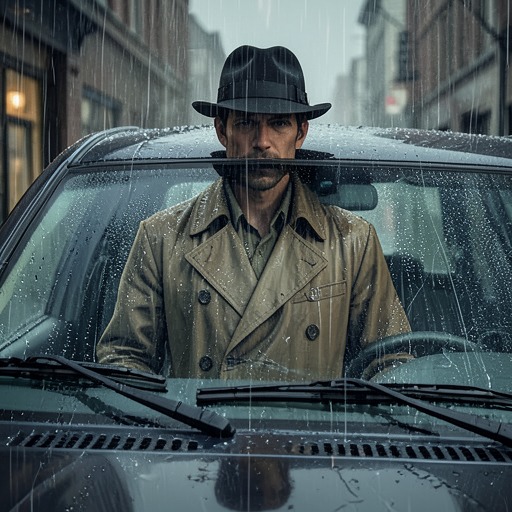
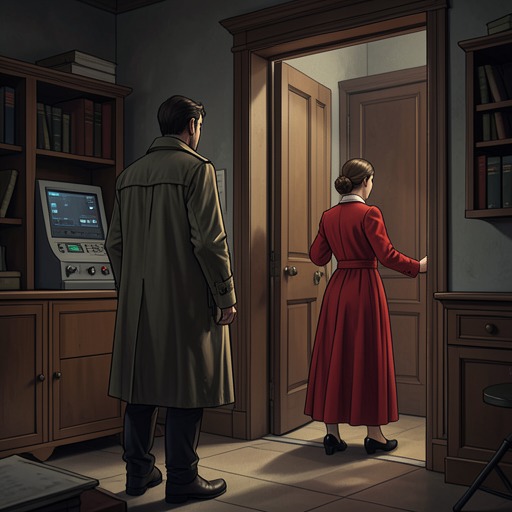
Carol Lundgren kills Joe Brody and is captured
The Big SleepCarol Lundgren kills Joe Brody and is captured after pursuing him to his apartment. The murder turns the struggle over Arthur Geiger’s illicit business and Carmen Sternwood’s photographs into a personal act of lethal retaliation: Lundgren kills Brody, but Philip Marlowe stops his escape and secures the weapon that connects him to the shooting.
Causes and Background
Lundgren’s pursuit of Brody grows out of his intimate connection to Arthur Geiger. After Geiger’s murder, Marlowe finds the body missing from Geiger’s house; the removal leaves a rug in the place where the body had been and strips of embroidered silk missing from the wall. These details establish that someone has intervened in the scene, but they do not yet explain Lundgren’s later attack on Brody.
The killing takes place amid the struggle over Geiger’s operation. Brody has become involved in taking over Geiger’s illicit book business and in the attempt to use Carmen’s nude photographs against the Sternwood family. The evidence at the shooting scene, however, is most direct about Lundgren’s action and the circumstances of Brody’s death; it does not provide a complete account of Lundgren’s understanding of Brody’s role or every step that led him to the apartment.
The Shooting
At Brody’s apartment, Marlowe warns Brody that Lundgren may have returned. Brody says he has had enough of hiding and takes a Colt from the desk. Holding the gun at his side, he opens the door a short distance and leans toward the opening. A voice calls Brody’s name. Brody answers, but Marlowe cannot hear what he says; two quick, muffled shots follow.
Brody falls against the door, which closes under his weight. He slides to the floor and becomes still, the Colt remaining in his hand. Marlowe crosses the room, moves Brody enough to open the door, and sees a woman looking out from a nearby doorway in alarm. Her presence registers the shock of the shooting in the apartment, but she does not identify the departing assailant.
Marlowe hears running footsteps on the tile stairs and pursues the sound. Outside, he sees a tall, hatless figure in a leather jerkin running between parked cars. The figure turns and fires toward him, then disappears between the cars. Marlowe is now pursuing the shooter, but the gunfire allows the fugitive to break away before he can be caught at the apartment building.
Marlowe’s Interception and Capture
Rather than continue directly after the fleeing figure, Marlowe gets into his car and drives down the hill at a measured pace. No car pulls away from the opposite side of the street. He hears what may be footsteps, turns back, and then makes out a faint, cheerful whistle followed by approaching steps. The delay and return put him in position to meet the runner away from the building.
Marlowe takes Carmen’s small revolver from his pocket and waits low between parked cars. When the young man in the jerkin appears, whistling, Marlowe steps out and addresses him. The youth reaches inside the jerkin; Marlowe presses the revolver against his stomach and warns that he can shoot. The young man resists verbally, then lets his hand fall away and asks what Marlowe wants. Marlowe takes an automatic pistol from inside the jerkin and orders him into the car. The youth complies, and Marlowe takes him away under control.
The weapon Marlowe retrieves is distinct from the Colt Brody held when he fell: it is the automatic concealed in the pursuer’s jerkin. That distinction matters to the case. Brody’s gun is left with his body, while the automatic supplies evidence against the young man Marlowe has stopped after the shooting.
Identification and Consequences
The captured youth is brought before Bernie Ohls, who asks whether he admits shooting Brody. The young man gives no useful admission. Marlowe answers that an admission is unnecessary because he has the gun. The exchange makes the practical basis of the capture clear: the case does not depend on Lundgren confessing, because Marlowe has taken the concealed weapon from him.
The event resolves the immediate danger to Marlowe and ends Lundgren’s flight from the apartment building in custody rather than escape. Brody is dead, and Lundgren is held in connection with his killing. The available evidence establishes the shooting, the pursuit, the recovered automatic, and the questioning; it does not recount the full subsequent legal disposition.
Narrative Significance
The murder joins two strands of the investigation that had first appeared separate. Geiger’s death and the missing body leave Marlowe with an altered crime scene; Brody’s death then brings the hidden loyalties surrounding Geiger into the open through Lundgren’s attack. The investigation’s movement from disturbed evidence to an observed shooting and a recovered gun gives the violence a chain of material consequences, even as the motives behind each participant’s actions remain unevenly disclosed.
The scene also turns on a reversal of pursuit. Lundgren first escapes into the street, and Marlowe seems to have lost him; by driving away and circling back, Marlowe places himself in the fugitive’s path. The capture therefore follows not from an immediate chase alone but from his decision to wait for the runner’s return, with Carmen’s revolver and Lundgren’s concealed automatic marking the shift from flight to control.